
UniProt data
UniProt name: LY9_HUMAN (Q9HBG7)
Gene name: LY9; ORFNames=CDABP0070
Organism: Homo sapiens (Human).
Function: Self-ligand receptor of the signaling lymphocytic activation molecule (SLAM) family. SLAM receptors triggered by homo- or heterotypic cell-cell interactions are modulating the activation and differentiation of a wide variety of immune cells and thus are involved in the regulation and interconnection of both innate and adaptive immune response. Activities are controlled by presence or absence of small cytoplasmic adapter proteins, SH2D1A/SAP and/or SH2D1B/EAT-2. May participate in adhesion reactions between T lymphocytes and accessory cells by homophilic interaction. Promotes T-cell differentiation into a helper T-cell Th17 phenotype leading to increased IL-17 secretion; the costimulatory activity requires SH2D1A (PubMed:22184727). Promotes recruitment of RORC to the IL-17 promoter (PubMed:22989874). May be involved in the maintenance of peripheral cell tolerance by serving as a negative regulator of the immune response. May disable autoantibody responses and inhibit IFN-gamma secretion by CD4(+) T-cells. May negatively regulate the size of thymic innate CD8(+) T-cells and the development of invariant natural killer T (iNKT) cells (By similarity). {ECO:0000250|UniProtKB:Q01965, ECO:0000269|PubMed:22184727, ECO:0000269|PubMed:22989874}.
Subcellular location: Membrane; Single-pass type I membrane protein. Cell membrane {ECO:0000305}.
Transmembrane domains:
- 455-476, 22 AA, Helical. {ECO:0000255}.
Sequence: 655 AA
CATM prediction
The sequence of LY9_HUMAN returned 1 potential models
The positions at the dimer's interface are highlighted in yellow. The position at the crossing point is highlighted in orange.
| # | Sequence and interface | d | θ | Z' | ω' | Score |
|---|---|---|---|---|---|---|
| 460 470 + | + | + |
(Å) | (°) | (Å) | (°) | ||
| Model 1 | NTKLWIGLFLMVCLLCVGIFSWCIWKRK | 7.3 | -45.0° | 4.0 | 39.0 | -7.6 |
Click on the model number to visualize its details below.
MODEL 1 DETAILS
Precited structure:
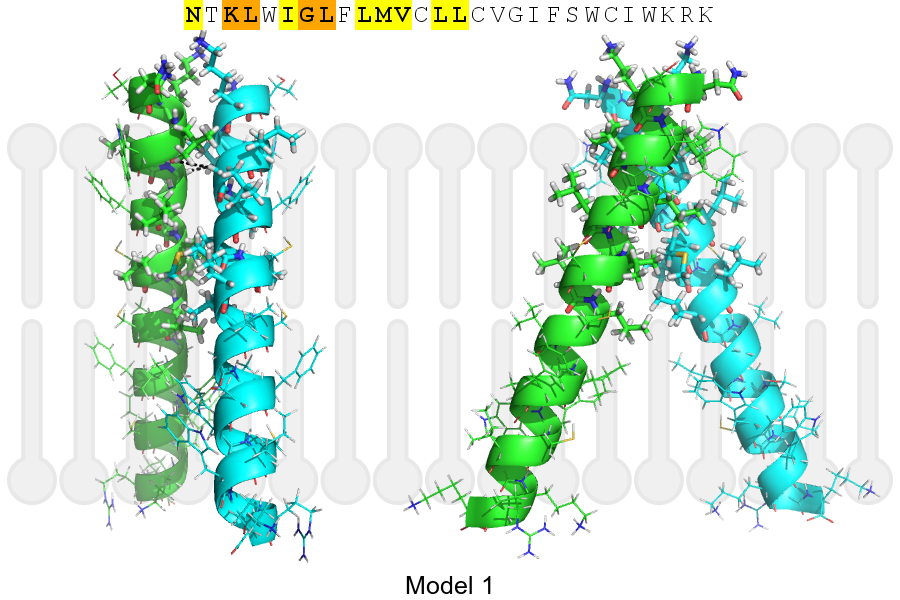
Click on the image to enlarge
Download model 1 structure: PDB, PyMOL session
List of hydrogen bonds:
| Donor | Acceptor | Distance |
|---|---|---|
| B, 458, GLY, HA1 | A, 455, LEU, O | 3.39Å |
| A, 458, GLY, HA1 | B, 455, LEU, O | 3.39Å |