
UniProt data
UniProt name: CD244_HUMAN (Q9BZW8)
Gene name: CD244; Synonyms=2B4
Organism: Homo sapiens (Human).
Function: Heterophilic receptor of the signaling lymphocytic activation molecule (SLAM) family; its ligand is CD48. SLAM receptors triggered by homo- or heterotypic cell-cell interactions are modulating the activation and differentiation of a wide variety of immune cells and thus are involved in the regulation and interconnection of both innate and adaptive immune response. Activities are controlled by presence or absence of small cytoplasmic adapter proteins, SH2D1A/SAP and/or SH2D1B/EAT-2. Acts as activating natural killer (NK) cell receptor (PubMed:10359122, PubMed:8376943, PubMed:11714776). Activating function implicates association with SH2D1A and FYN (PubMed:15713798). Downstreaming signaling involves predominantly VAV1, and, to a lesser degree, INPP5D/SHIP1 and CBL. Signal attenuation in the absence of SH2D1A is proposed to be dependent on INPP5D and to a lesser extent PTPN6/SHP-1 and PTPN11/SHP-2 (PubMed:10934222, PubMed:15713798). Stimulates NK cell cytotoxicity, production of IFN-gamma and granule exocytosis (PubMed:8376943, PubMed:11714776). Optimal expansion and activation of NK cells seems to be dependent on the engagement of CD244 with CD48 expressed on neighboring NK cells (By similarity). Acts as costimulator in NK activation by enhancing signals by other NK receptors such as NCR3 and NCR1 (PubMed:10741393). At early stages of NK cell differentiation may function as an inhibitory receptor possibly ensuring the self- tolerance of developing NK cells (PubMed:11917118). Involved in the regulation of CD8(+) T-cell proliferation; expression on activated T-cells and binding to CD488 provides costimulatory-like function for neighboring T-cells (By similarity). Inhibits inflammatory responses in dendritic cells (DCs) (By similarity). {ECO:0000250|UniProtKB:Q07763, ECO:0000269|PubMed:10359122, ECO:0000269|PubMed:10741393, ECO:0000269|PubMed:10934222, ECO:0000269|PubMed:11714776, ECO:0000269|PubMed:11917118, ECO:0000269|PubMed:8376943, ECO:0000305|PubMed:15713798}.
Subcellular location: Membrane {ECO:0000305}; Single-pass type I membrane protein {ECO:0000305}. Cell membrane {ECO:0000305}. Note=Receptor engagement results in a recruitment to lipid drafts essential for the subsequent tyrosine phosphorylation of the ITSMs. {ECO:0000269|PubMed:11034353}.
Transmembrane domains:
- 230-250, 21 AA, Helical. {ECO:0000255}.
Sequence: 370 AA
CATM prediction
The sequence of CD244_HUMAN returned 1 potential models
The positions at the dimer's interface are highlighted in yellow. The position at the crossing point is highlighted in orange.
| # | Sequence and interface | d | θ | Z' | ω' | Score |
|---|---|---|---|---|---|---|
| 230 240 250 | + | + | |
(Å) | (°) | (Å) | (°) | ||
| Model 1 | FWAFLVIIVILSALFLGTLACFCVWRR | 6.8 | -46.2° | 2.7 | 47.0 | -19.3 |
| Prolines* | FWPFLVIIVILSALFLGTLACFCVWRR |
* Note: this sequence contains Pro residues. CATM substituted them with Ala during the modeling. The positions are marked.
Click on the model number to visualize its details below.
MODEL 1 DETAILS
Precited structure:
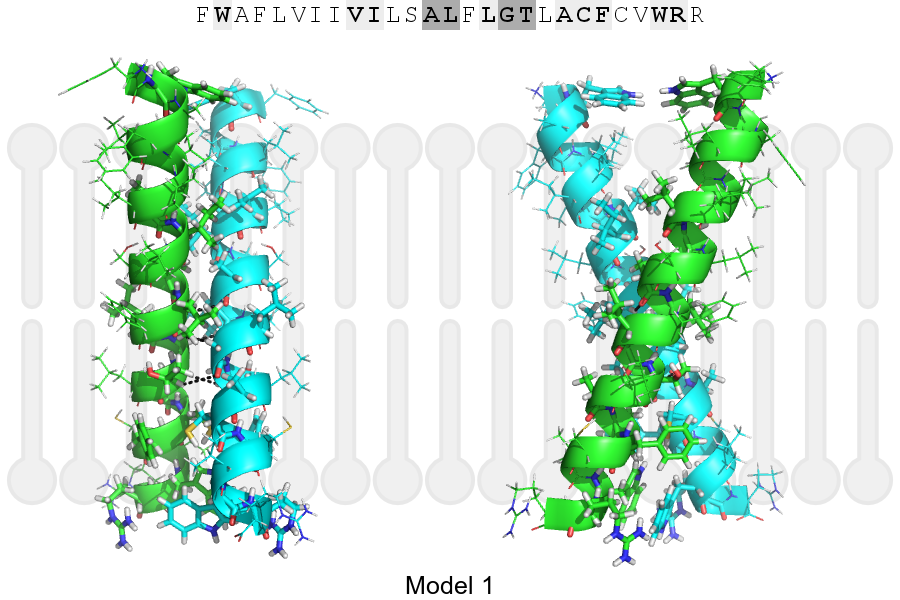
Click on the image to enlarge
Download model 1 structure: PDB, PyMOL session
List of hydrogen bonds:
| Donor | Acceptor | Distance |
|---|---|---|
| B, 240, LEU, HA | A, 239, ALA, O | 2.85Å |
| B, 243, GLY, HA1 | A, 240, LEU, O | 2.82Å |
| B, 244, THR, HA | A, 243, GLY, O | 3.47Å |
| A, 240, LEU, HA | B, 239, ALA, O | 2.85Å |
| A, 243, GLY, HA1 | B, 240, LEU, O | 2.82Å |
| A, 244, THR, HA | B, 243, GLY, O | 3.47Å |