
UniProt data
UniProt name: SEPR_HUMAN (Q12884)
Gene name: FAP {ECO:0000312|HGNC:HGNC:3590}
Organism: Homo sapiens (Human).
Function: Cell surface glycoprotein serine protease that participates in extracellular matrix degradation and involved in many cellular processes including tissue remodeling, fibrosis, wound healing, inflammation and tumor growth. Both plasma membrane and soluble forms exhibit post-proline cleaving endopeptidase activity, with a marked preference for Ala/Ser-Gly-Pro-Ser/Asn/Ala consensus sequences, on substrate such as alpha-2-antiplasmin SERPINF2 and SPRY2 (PubMed:14751930, PubMed:16223769, PubMed:16480718, PubMed:16410248, PubMed:17381073, PubMed:18095711, PubMed:21288888, PubMed:24371721). Degrade also gelatin, heat-denatured type I collagen, but not native collagen type I and IV, vibronectin, tenascin, laminin, fibronectin, fibrin or casein (PubMed:9065413, PubMed:2172980, PubMed:7923219, PubMed:10347120, PubMed:10455171, PubMed:12376466, PubMed:16223769, PubMed:16651416, PubMed:18095711). Have also dipeptidyl peptidase activity, exhibiting the ability to hydrolyze the prolyl bond two residues from the N-terminus of synthetic dipeptide substrates provided that the penultimate residue is proline, with a preference for Ala-Pro, Ile-Pro, Gly-Pro, Arg-Pro and Pro-Pro (PubMed:10347120, PubMed:10593948, PubMed:16175601, PubMed:16223769, PubMed:16651416, PubMed:16410248, PubMed:17381073, PubMed:21314817, PubMed:24371721, PubMed:24717288). Natural neuropeptide hormones for dipeptidyl peptidase are the neuropeptide Y (NPY), peptide YY (PYY), substance P (TAC1) and brain natriuretic peptide 32 (NPPB) (PubMed:21314817). The plasma membrane form, in association with either DPP4, PLAUR or integrins, is involved in the pericellular proteolysis of the extracellular matrix (ECM), and hence promotes cell adhesion, migration and invasion through the ECM. Plays a role in tissue remodeling during development and wound healing. Participates in the cell invasiveness towards the ECM in malignant melanoma cancers. Enhances tumor growth progression by increasing angiogenesis, collagen fiber degradation and apoptosis and by reducing antitumor response of the immune system. Promotes glioma cell invasion through the brain parenchyma by degrading the proteoglycan brevican. Acts as a tumor suppressor in melanocytic cells through regulation of cell proliferation and survival in a serine protease activity-independent manner. {ECO:0000250|UniProtKB:P97321, ECO:0000269|PubMed:10347120, ECO:0000269|PubMed:10455171, ECO:0000269|PubMed:10593948, ECO:0000269|PubMed:12376466, ECO:0000269|PubMed:14751930, ECO:0000269|PubMed:16175601, ECO:0000269|PubMed:16223769, ECO:0000269|PubMed:16410248, ECO:0000269|PubMed:16480718, ECO:0000269|PubMed:16651416, ECO:0000269|PubMed:17105646, ECO:0000269|PubMed:17381073, ECO:0000269|PubMed:18095711, ECO:0000269|PubMed:20707604, ECO:0000269|PubMed:21288888, ECO:0000269|PubMed:21314817, ECO:0000269|PubMed:2172980, ECO:0000269|PubMed:24371721, ECO:0000269|PubMed:24717288, ECO:0000269|PubMed:7923219, ECO:0000269|PubMed:9065413}.
Subcellular location: Isoform 2: Cytoplasm {ECO:0000303|PubMed:10644713}.
Transmembrane domains:
- 5-25, 21 AA, Helical; Signal-anchor for type II membrane protein. {ECO:0000255}.
Sequence: 760 AA
CATM prediction
The sequence of SEPR_HUMAN returned 1 potential models
The positions at the dimer's interface are highlighted in yellow. The position at the crossing point is highlighted in orange.
| # | Sequence and interface | d | θ | Z' | ω' | Score |
|---|---|---|---|---|---|---|
| 10 20 + | + | + |
(Å) | (°) | (Å) | (°) | ||
| Model 1 | KTWVKIVFGVATSAVLALLVMCIVLRA | 7.3 | -51.8° | 0.6 | 48.3 | -16.9 |
| Prolines* | KTWVKIVFGVATSAVLALLVMCIVLRP |
* Note: this sequence contains Pro residues. CATM substituted them with Ala during the modeling. The positions are marked.
Click on the model number to visualize its details below.
MODEL 1 DETAILS
Precited structure:
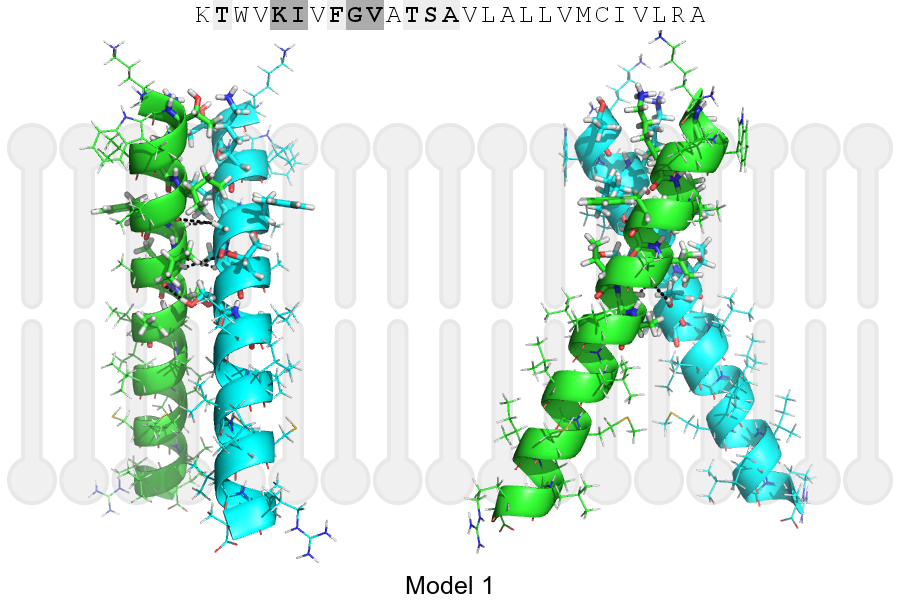
Click on the image to enlarge
Download model 1 structure: PDB, PyMOL session
List of hydrogen bonds:
| Donor | Acceptor | Distance |
|---|---|---|
| B, 10, GLY, HA1 | A, 7, ILE, O | 3.43Å |
| B, 11, VAL, HA | A, 10, GLY, O | 3.37Å |
| B, 14, SER, HG1 | A, 11, VAL, O | 2.41Å |
| A, 10, GLY, HA1 | B, 7, ILE, O | 3.43Å |
| A, 11, VAL, HA | B, 10, GLY, O | 3.37Å |
| A, 14, SER, HG1 | B, 11, VAL, O | 2.41Å |