UniProt data
UniProt name: CD6_HUMAN (P30203)
Gene name: CD6
Organism: Homo sapiens (Human).
Function: Cell adhesion molecule that mediates cell-cell contacts and regulates T-cell responses via its interaction with ALCAM/CD166 (PubMed:15048703, PubMed:15294938, PubMed:16352806, PubMed:16914752, PubMed:24945728, PubMed:24584089). Contributes to signaling cascades triggered by activation of the TCR/CD3 complex (PubMed:24584089). Functions as costimulatory molecule; promotes T-cell activation and proliferation (PubMed:15294938, PubMed:16352806, PubMed:16914752). Contributes to the formation and maturation of the immunological synapse (PubMed:15294938, PubMed:16352806). Functions as calcium-dependent pattern receptor that binds and aggregates both Gram-positive and Gram-negative bacteria. Binds both lipopolysaccharide (LPS) from Gram-negative bacteria and lipoteichoic acid from Gram-positive bacteria (PubMed:17601777). LPS binding leads to the activation of signaling cascades and down-stream MAP kinases (PubMed:17601777). Mediates activation of the inflammatory response and the secretion of pro-inflammatory cytokines in response to LPS (PubMed:17601777). {ECO:0000269|PubMed:15048703, ECO:0000269|PubMed:15294938, ECO:0000269|PubMed:16352806, ECO:0000269|PubMed:16914752, ECO:0000269|PubMed:17601777, ECO:0000269|PubMed:24584089, ECO:0000269|PubMed:24945728}.
Subcellular location: Soluble CD6: Secreted {ECO:0000269|PubMed:17601777}. Note=The origins of the secreted form are not clear, but it might be created by proteolytic shedding of the ectodomain. {ECO:0000305}.
Transmembrane domains:
- 403-423, 21 AA, Helical. {ECO:0000255}.
Sequence: 668 AA
CATM prediction
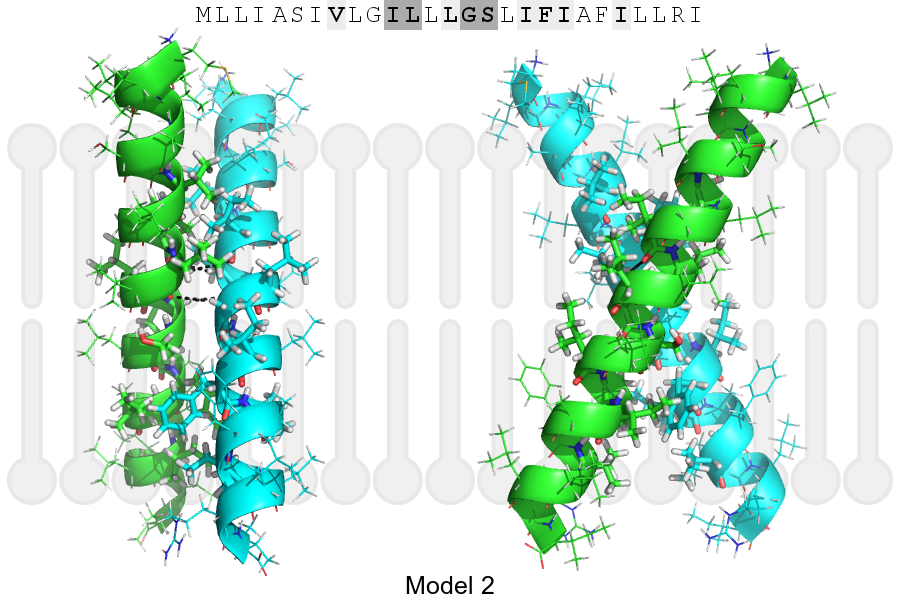
The sequence of CD6_HUMAN returned 2 potential models
The positions at the dimer's interface are highlighted in yellow. The position at the crossing point is highlighted in orange.
| # | Sequence and interface | d | θ | Z' | ω' | Score |
|---|---|---|---|---|---|---|
| 400 410 420 | + | + | + |
(Å) | (°) | (Å) | (°) | ||
| Model 1 | MLLIASIVLGILLLGSLIFIAFILLRI | 6.9 | -55.3° | 2.4 | 47.7 | -23.1 |
| Model 2 | MLLIASIVLGILLLGSLIFIAFILLRI | 7.3 | -55.0° | 2.4 | 47.8 | -7.0 |
| Prolines* | MLLIPSIVLGILLLGSLIFIAFILLRI |
* Note: this sequence contains Pro residues. CATM substituted them with Ala during the modeling. The positions are marked.
Click on the model number to visualize its details below.
MODEL 1 DETAILS
Precited structure:
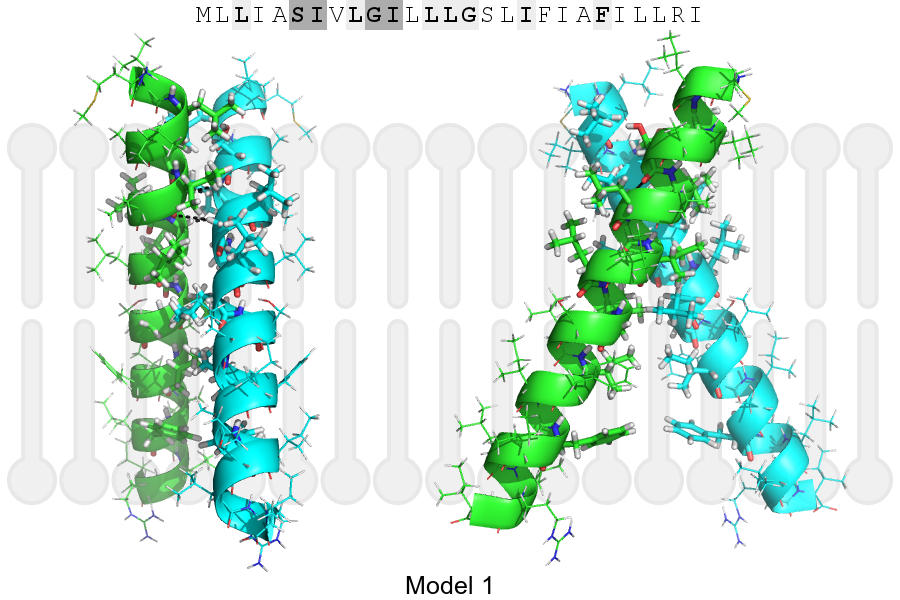
Click on the image to enlarge
Download model 1 structure: PDB, PyMOL session
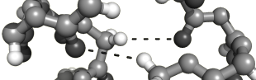
List of hydrogen bonds:
| Donor | Acceptor | Distance |
|---|---|---|
| B, 406, ILE, HA | A, 405, SER, O | 3.16Å |
| B, 409, GLY, HA1 | A, 406, ILE, O | 2.88Å |
| A, 406, ILE, HA | B, 405, SER, O | 3.16Å |
| A, 409, GLY, HA1 | B, 406, ILE, O | 2.88Å |