
UniProt data
UniProt name: DPP4_HUMAN (P27487)
Gene name: DPP4; Synonyms=ADCP2, CD26
Organism: Homo sapiens (Human).
Function: Cell surface glycoprotein receptor involved in the costimulatory signal essential for T-cell receptor (TCR)-mediated T-cell activation. Acts as a positive regulator of T-cell coactivation, by binding at least ADA, CAV1, IGF2R, and PTPRC. Its binding to CAV1 and CARD11 induces T-cell proliferation and NF- kappa-B activation in a T-cell receptor/CD3-dependent manner. Its interaction with ADA also regulates lymphocyte-epithelial cell adhesion. In association with FAP is involved in the pericellular proteolysis of the extracellular matrix (ECM), the migration and invasion of endothelial cells into the ECM. May be involved in the promotion of lymphatic endothelial cells adhesion, migration and tube formation. When overexpressed, enhanced cell proliferation, a process inhibited by GPC3. Acts also as a serine exopeptidase with a dipeptidyl peptidase activity that regulates various physiological processes by cleaving peptides in the circulation, including many chemokines, mitogenic growth factors, neuropeptides and peptide hormones. Removes N-terminal dipeptides sequentially from polypeptides having unsubstituted N-termini provided that the penultimate residue is proline. {ECO:0000269|PubMed:10570924, ECO:0000269|PubMed:10593948, ECO:0000269|PubMed:10900005, ECO:0000269|PubMed:10951221, ECO:0000269|PubMed:11772392, ECO:0000269|PubMed:14691230, ECO:0000269|PubMed:16651416, ECO:0000269|PubMed:17287217, ECO:0000269|PubMed:17549790, ECO:0000269|PubMed:18708048}.
Subcellular location: Cell membrane {ECO:0000269|PubMed:10900005, ECO:0000269|PubMed:11772392, ECO:0000305|PubMed:8101391}; Single- pass type II membrane protein. Apical cell membrane {ECO:0000269|PubMed:11773049}; Single-pass type II membrane protein. Cell projection, invadopodium membrane {ECO:0000269|PubMed:16651416}; Single-pass type II membrane protein. Cell projection, lamellipodium membrane {ECO:0000269|PubMed:16651416}; Single-pass type II membrane protein. Cell junction {ECO:0000269|PubMed:11772392}. Membrane raft {ECO:0000269|PubMed:17287217}. Note=Translocated to the apical membrane through the concerted action of N- and O-Glycans and its association with lipid microdomains containing cholesterol and sphingolipids (PubMed:11773049). Redistributed to membrane rafts in T-cell in a interleukin-12-dependent activation (PubMed:12676959). Its interaction with CAV1 is necessary for its translocation to membrane rafts (PubMed:17287217). Colocalized with PTPRC in membrane rafts (PubMed:12676959). Colocalized with FAP in invadopodia and lamellipodia of migratory activated endothelial cells in collagenous matrix. Colocalized with FAP on endothelial cells of capillary-like microvessels but not large vessels within invasive breast ductal carcinoma (PubMed:16651416). Colocalized with ADA at the cell junction in lymphocyte-epithelial cell adhesion (PubMed:11772392). Colocalized with IGF2R in internalized cytoplasmic vesicles adjacent to the cell surface (PubMed:10900005). {ECO:0000269|PubMed:10900005, ECO:0000269|PubMed:11772392, ECO:0000269|PubMed:11773049, ECO:0000269|PubMed:12676959, ECO:0000269|PubMed:16651416, ECO:0000269|PubMed:17287217}.
Transmembrane domains:
- 7-28, 22 AA, Helical; Signal-anchor for type II membrane protein. {ECO:0000255}.
Sequence: 766 AA
CATM prediction
The sequence of DPP4_HUMAN returned 1 potential models
The positions at the dimer's interface are highlighted in yellow. The position at the crossing point is highlighted in orange.
| # | Sequence and interface | d | θ | Z' | ω' | Score |
|---|---|---|---|---|---|---|
| 10 20 30 + | + | + | |
(Å) | (°) | (Å) | (°) | ||
| Model 1 | AWKVLLGLLGAAALVTIITVAVVLLNKG | 7.0 | -45.7° | 2.7 | 47.0 | -18.0 |
| Prolines* | PWKVLLGLLGAAALVTIITVPVVLLNKG |
* Note: this sequence contains Pro residues. CATM substituted them with Ala during the modeling. The positions are marked.
Click on the model number to visualize its details below.
MODEL 1 DETAILS
Precited structure:
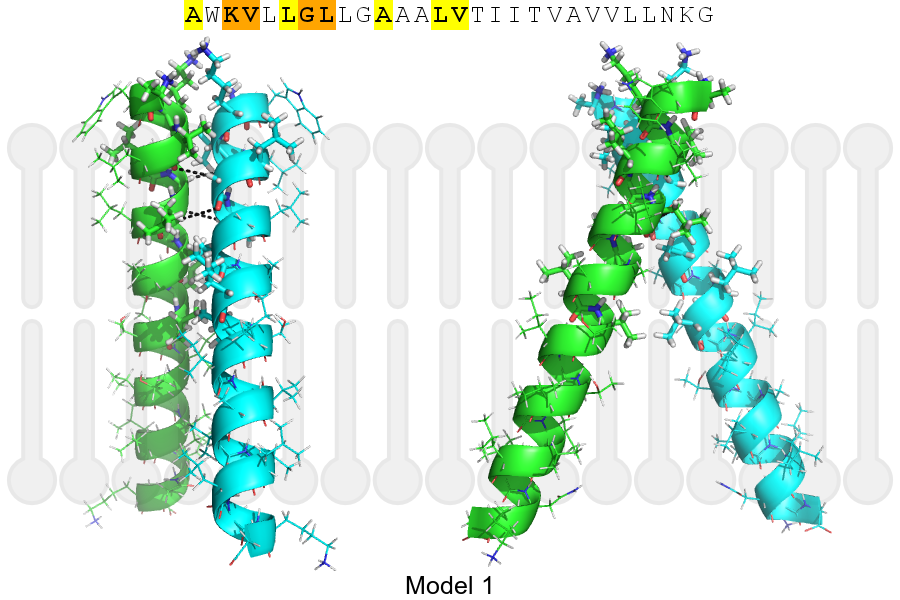
Click on the image to enlarge
Download model 1 structure: PDB, PyMOL session
List of hydrogen bonds:
| Donor | Acceptor | Distance |
|---|---|---|
| B, 10, GLY, HA1 | A, 7, VAL, O | 2.96Å |
| B, 11, LEU, HA | A, 10, GLY, O | 3.50Å |
| A, 10, GLY, HA1 | B, 7, VAL, O | 2.96Å |
| A, 11, LEU, HA | B, 10, GLY, O | 3.50Å |